
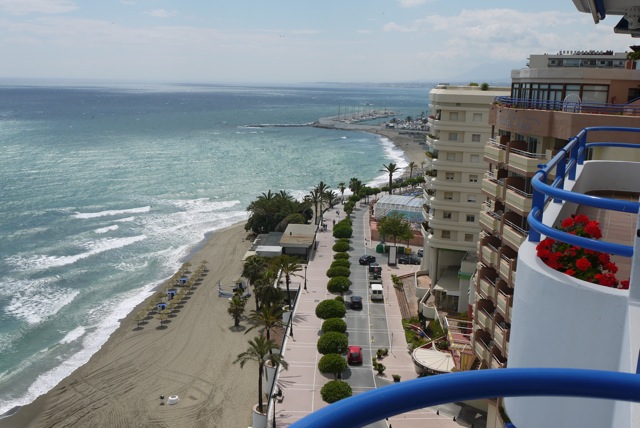
A fog rolled in giving Marbella a gloomy feel. A beach front cafe raised the price of a fruit shake from four euros to eight euros. The magic of the Spanish locals strolling along the promenade living their unique lifestyle was replaced by large groups of tourists eating ice cream cones and British guys walking shirtless with their hairy, sunburnt bellies sticking straight out like red torpedoes.
Mosquitoes swarmed in our apartment with no screens on the sliding glass doors to keep them out. Motorcycles with no mufflers hit the streets. Cars honked their horns and blasted music. Tour busses dumped hordes of tourists into the old town where they walked four abreast in the narrow streets, while the sound of carpenter’s saws, sanders, and hammers filled the air. It was as though the town of Marbella started to spin at 78 rpm’s instead of 33 rpm’s.
The high season had arrived on the Costa del Sol.
Finally I understood why this area had such a bad reputation. The latest edition of the Lonely Planet guide book on Andalucia recommended almost nothing along the Costa del Sol: “The Costa del Sol stretches along the Malaga seaboard like a wall of wedding cakes several kilometers thick – think tacky resort towns like Fuengirola, Torremolinos, Benalmadena and Marbella – all the way down the southwestern coast to the border of Cadiz. Launched as a Francoist development drive for the impoverished Andalucia, the Costa del Sol is an eye-stinging example of how to fill all open spaces with concrete buildings and paying customers.”
After reading the guide book we almost didn’t go to Marbella. Since we were there in the off season, we found it, and the people who lived there, to be delightful. I hoped the guidebook writers would keep showing up in the high season so Marbella remained innately Spanish for the rest of the year.
After less than three months in Spain I couldn’t begin to understand what made Spain what it was. I knew Spain wasn’t the deeply conservative, religious country it used to be during Franco’s regime. Still I was surprised to see how sexy the women dressed, even to Sunday mass, where there was a constant parade of short skirts, tight blouses showing lots of cleavage and sparkling disco style dresses worn with high stiletto heels. People came and went during the church service to stand outside to chat with friends, have a cigarette or even to embrace by the church doors.
I was curious about Spain’s current social situation. Here’s what I found out from my research and from what people shared with me:
During the boom times, which ended in 2008, Spain put all of its EU funding into schools, hospitals, highways and high speed trains. Spain was the fourth largest manufacturer in the world of solar power technology.
Since 2004 when the liberal socialist Jose Luis Rodriguez Zapatero was elected prime minister (and reelected in 2008) he created bills to expand individual rights and social reforms. Under Zapatero’s new social laws Spain became on of the most liberal countries in the EU. In 2005 a bill was passed that legalized same-sex marriage (including adoption rights) and expanded abortion rights. As of January, 2011 Spain had the strictest non-smoking laws in the EU. Zapatero created systems to better integrate immigrants, raised the minimum wage and reduced the role of religion in schools (much to the disdain of the Roman Catholic Church).
Zapatero launched a crusade against domestic violence and legalized the “express divorce” that allowed couples to divorce, with no evidence of blame, after only three months of separation, instead of one year. Under Franco, since the church prohibited divorce, the only way for a couple to end their marriage was by an arduous and expensive procedure of annulment or legal separation, both almost impossible to obtain.
Divorce was legalized in 1981 but because of the legal and financial obstacles to a formal split and the social stigma, particularly for women, attached to failed marriages, many couples chose to simply live apart. This unofficial separation was known as the “Spanish divorce.” This arrangement made the actual divorce rate in Spain the lowest in Europe but now, with the “express divorce,” Spain has one of the highest divorce rates in the EU with 1 in 2.3 marriages ending in divorce.
While in office Prime Minister Zapertero always had his critics, those who said his social policies harmed the traditional Spanish lifestyle. After ten years of record growth in Spain he had to introduce austerity measures to help the economy and lower the high unemployment rates (the average rate is 21.7% but in Andalucia the rate is 29.68% – compared with just 11.6% in the Basque Country. For young people under 25 years old the unemployment rate is closer to 50%). In a country of 46 million nearly 5 million people were out of work. Zapertero was the fall guy and his popularity has fallen across the board. He’s announced he won’t be running for re-election next year.
Spain Tidbits:
Adios
A Spanish friend we met, Jose, who owns a hotel in Marbella told us a funny story: “My British wife always gets upset with me because a two minute walk to the store takes me fifteen minutes because I run into so many people I know. I have stop to say hello to each one. So whenever I’m in a hurry I take back streets and alternative routes to avoid seeing people.”
I asked him why people sometimes greet each other by saying adios instead of hola. “It’s for the same reason,” he said. “If you’re in a hurry you acknowledge the person with a quick hand wave or nod of the head, which serves as the hello, but without slowing your stride you say adios so they know you don’t have time to stop and talk.”
Ham Por Favor
A Canadian friend, Lari, told us a story about why she decided to live inland where there were no other English speakers when she first moved to Spain many years ago: “When I first arrived we went to the coast. I was at a supermarket waiting to be served when a British man stepped up to the counter and asked in English for three pieces of ham sliced thinly. The woman behind the counter didn’t understand him, so he yelled it at her again. When she still didn’t understand what the man wanted I translated for her. The man turned to me and said, ‘I’ve lived here thirty years and they still don’t know what I want.’ I knew then I had to be surrounded by locals away from the coast.”
Old Man pick up
One evening as I waited for Cradoc in front of our apartment building I sat on the bench and took photographs of people passing by. I saw a tiny older man walking directly towards me and quickly shot a photo. He stopped and stood staring at me through thick glasses and gave me a toothless smile. He asked me questions I kept trying to answer in French instead of my more limited Spanish; where was I from, what state did I live in, how old was I?
Juan told me he was from Cordova, the land of bull fighting. As he said this he put his five foot no inch body into a macho bull fighter stance and waved an imaginary red cape. Then he sat close to me on the bench. When Cradoc came over I introduced him and I asked Jose if he was married. He shook he head sadly and said, “No, soy soltero.”
As we wandered off I said, “Now that I’m over fifty only old men flirt with me.”
“Well at least he had two teeth left,” Cradoc said.


No Comments