
I first came to Spain in January, 1991 during a nine month European back packing trip with my husband, Cradoc. We’d been on the road since October, 1990 during a record breaking cold winter. We needed warmth and sunshine and decided to head south to Andalusia. On the overnight train from Barcelona I remember lying in my bunk thinking that the trains in Spain were surprisingly smooth and quiet. We woke up in the morning to find the train had been sitting on a siding all night. First for repairs, then because of that delay, it had to wait for the northbound train to come by on the antiquated single line that ran from the north of Spain to the south (now because of money poured into the country by the EU Spain has some of the fastest and most modern trains in the world). People were hungry and the conductors handed out an emergency stash of warm beers and stale bread with dried salami for breakfast. We arrived at our destination at 5:00 PM, ten hours late.
We chose to go to Estepona, an old fishing village turned resort town on the Costa del Sol, because a friend’s parents lived there. They moved to Spain in the 1970’s to start an aloe vera farm. We arrived the day before the U.S. started bombing Kuwait during the first Gulf War. We stayed for two months. The weather was rainy and cold and our apartment only had one portable butane heater we moved from room to room. It did nothing to warm us. The tourists stayed home because of the war and businesses were hurting. The dollar was weak and the Middle East was in the headlines.
Twenty years later everything’s the same, except there are more apartment complexes and new roads. After three years of a depressed economy in Spain businesses are closed with Se Aquilla (for rent) signs on the store fronts. Se Vende (for sale) signs hang from a large number of apartment patios. The dollar is weak and the Middle East is again in the headlines.
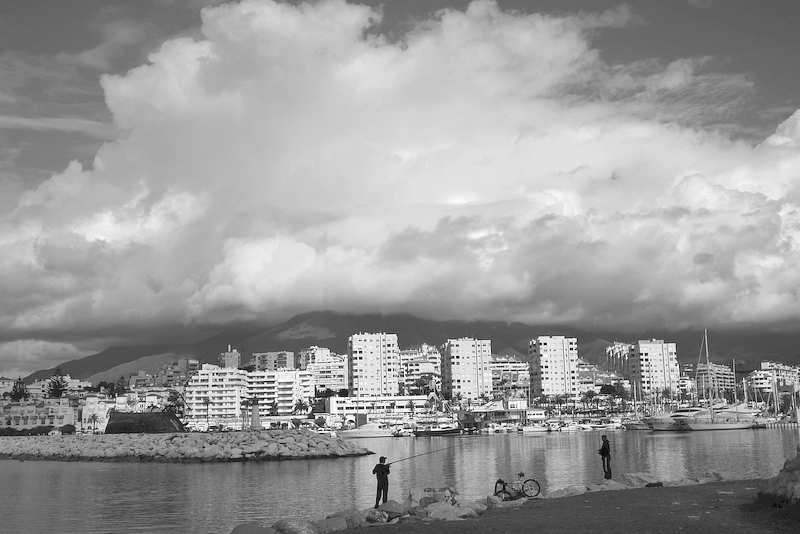
Estepona port after storm
Estepona, a town of around 60,000, is known for its clean, sandy beaches. Even with its rows of apartment blocks along the coast, it is one of the only towns along the Costa del Sol that has been able to hold onto some of it’s Spanish character with a white walled old town, narrow cobbled streets and flowered plazas. In the early 1990’s Estepona was chosen as the original site by Walt Disney for the Eurodisney project. Luckily Disney changed their mind and later “awarded” the installation to Paris.
We look out our apartment windows to a bullring below us, the Mediterranean sea and the marina to the right and a wall off apartments running up the hill that used to be an empty lot when we were here last with the Sierra Bermeja mountains as a back drop.
The weather was sunny on the day we arrived and then a massive storm rolled in with strong winds and heavy rain. Except for one more sunny day this past Saturday the rain has not stopped pounding the windows of our apartment, but this time we knew enough to rent an apartment that had a heating system. The Costa del Sol usually has the best winter climate in all of Europe. The latitude, at 36 degrees, is about the same as San Francisco. Europe is a far north continent with Paris being at the same latitude as Seattle. England is farther north than Vancouver, Canada. There aren’t many places for Europeans to escape to for the winter.
My dreams of Spain started in grammar school when I first learned about the country during Spanish lessons. But it was the author James Mitchner who lit a fire in me to see Spain when I read “Iberia” and “The Drifters” in my late teens.
Cradoc’s awareness of Europe started at ten years old when he discovered the photographs of the French photographer Henri Cartier-Bresson, “I saw those photographs and fell in love with France,” he told me. “In my early teens I started reading Ernest Hemingway and those books brought me from France down to Spain. In high school I listened to flamingo music and wore a pair of shoes I called my Spanish flamingo dancing boots; black leather, low topped boots with elastic sides. I loved those boots.”
During a low point in his life, when Cradoc was twenty, he went back home for Christmas. “For the first time ever my father was excited about the presents he’d gotten for me. When I opened the first gift and saw it was a can of smoked oysters I couldn’t figure out what the big deal was. As I opened gift after gift it turned out they were all from Spain, the biggest and best being a European style corduroy coat made in Spain that I wish I still had.
“My father didn’t talk much about how he felt,” Cradoc said. “He never did explain why he went on his Spanish gift buying binge, but his thoughtfulness touched me deeply. I had never talked to him about my interest in Spain. I think the Spanish gifts were part of my father’s own dreams of travel but he died at fifty-nine of lung cancer. He never got to Europe, or anywhere else out of North America.”
The man who helped us settle into our apartment, Vale, told us stories about the high times in Spain before the economic crash three years ago. He runs a cleaning company for many of the seasonal homes and apartments in the Estepona area. He has a group of women from places like the Ukraine who work for him as maids. At one time he had seven hundred apartments that they cleaned, but now 80% of those vacation apartments are empty.
“Land developers went crazy. Everyone was flying high. One of my clients owes me 40,000 euros,” said Vale. “Another guy who owes me money skipped out of Spain and crossed into Morocco. I’ll probably never see that money. They must think I have deep pockets and can afford the loss.”
“So the high flyers flew right out of Spain with other people’s money in their hands,” I said.
“Si, exacamento,” Vale said shrugging his shoulders. “But I am still a happy man. I have my health and my family. That is most important to me.”
Crime in Spain is on the increase. Scams are even more common. It’s estimated there are between 1 to 2 million new homes never sold sitting empty in Spain with 800,000 apartments along the Costa del Sol waiting to be sold. Thousands of Brits stand to lose their homes because, unknown to them, they were built without the proper permits. Because they were built illegally the government has decided to tear them down with no reimbursement to the owners. Some homes were built on land not owned by the land developer and sometimes even on protected lands. It all happened because the Spanish land developers, building companies, inspectors and the mayors were all giving and taking bribes.
I escaped all the scams in China, but on my first outing in Spain I was scammed. Two young boys came into the Thai restaurant in the port where we were having lunch. They were around 12 years old, dark haired with big brown eyes, cleanly dressed in their school clothes. They approached our table and said something in Spanish I didn’t understand. I asked one of the boys if he could speak English and he said, “We sell to raise money for school trip to France.” He held out a wad of blue coupons and continued, “One euro each.”
“What are they for?” I asked pointing to the coupons.
He babbled something in Spanish and repeated, “For school trip.”
The other smaller boy kept smiling and shaking his head up and down. They were cute Spanish school boys and we couldn’t turn them down. Cradoc bought one coupon from each boy. They tried at another table but were shooed away. They smiled and waved to us on their way out the door. Then Cradoc looked more closely at the coupon and laughed. “This is a coupon for an online betting site. The translation is ‘Deposit 100 euros with online betting.com and we’ll give you an additional 100 euros to bet with. Free!’”
We couldn’t picture a school in cahoots with an off track betting company and it only dawned on us then that we’d been had. Young scammers handing out the advertising of older scammers. The waitress confirmed this. “Oh, yes,” she said, “kids of all ages try all sorts of things like running in the restaurant saying their mother is sick on the street and they need money for water. I tell them I’ll give them some water and they mumble about needing a special kind of water.”
I turned to Cradoc and said, “Those boys are the future land developers of Spain.”
Many Dutch, Germans and Scandinavians escape to the Costa del Sol for the winter, but the Brits out number them all. The Brits who have retired to Spain have not had a good track record for integrating into the Spanish culture with many living in gated communities that offer all the comforts of home. Their excuse is the expat community is so large here they don’t need to learn Spanish or make Spanish friends. Along the coast most menus are in Spanish and English and in one town that the British have taken over, Nerja, the Spanish complain because most of the menus are only in English.
I wonder how the Brits get on without speaking Spanish because during Franco’s time the Spanish were not allowed to learn any foreign language. Even now all the movies and shows are dubbed with no subtitles. Being exposed to English is not something the young people grow up with. After Franco died in 1975 and English was taught in the schools the focus was on grammar and not conversational skills. Because of this the number of Spanish people who speak English is not high, even in the tourist towns.
The British “package holiday” was created in the 1960’s with trips to the Costa del Sol. The hot sun burnt their bodies and the cheap beer had them throwing up in the bars and they loved it all. The building boom of apartments along the coast followed and many Brits purchased second homes with low interest rates offered to entice foreigners to live in Spain. For retirees Spain has a good reputation with its health care, even better than the UK. But lately the Brits have started taking package tours to Turkey, Tunisia and Egypt instead of Spain because it’s much cheaper. Now the Spanish tourist board is doing all they can to woo them back.
Another group of immigrants in Spain are the Chinese. They started to come in the 1920’s and 30’s working as peddlers but most only started to arrive here after Franco’s death in the mid-70’s. In the last ten years so many of the convenience stores are owned by the Chinese that the stores are now called ‘chinos’, the Spanish word for Chinese. Many local business owners feel threatened because the Chinese have such a strong work ethic and a willingness to work long hours with no siesta, taking no days off and they have easy access to cheap goods.
We went into a ‘chino’ in Estepona to buy the biggest umbrellas we could find. The products they sold were the cheapest of the cheap. I didn’t see anything like this store when I was in China. But we did find huge umbrellas for 5 euros. The question is how long will they last?
We’ve enjoyed eating at many of the Asian restaurants that have opened along the coast since we were last here on our second visit in 1996. Unlike the Asian restaurants in France, which are basically French restaurants with a twist of Asia added, these restaurants are authentic. Except I find it hard to get any amount of vegetables served to me. When I asked a waitress about this she said, “Foreigners and the Spanish don’t like vegetables, so we don’t put many in our dishes.”
The other big import from China into Spain are black market cigarettes that have thirty times the levels of lead and six times the level of arsenic of regular cigarettes. Smoking one pack of these smuggled Chinese cigarettes is the equivalent of smoking six hundred cigarettes as far as the levels of chemicals inhaled into the body. Luckily we’ve arrived in Spain just in time for the new non-smoking law being strictly regulated with large fines for people and businesses who don’t comply with it.
We’ve come to Spain to see if we’d like to live here part-time. We’ve found the Spanish people to be kind and friendly. We study and practice our Spanish every day. Even the non-stop rain can’t discourage us (too much). But I wonder if I’d ever get used to the siesta/fiesta mañana lifestyle? Deep down Cradoc and I have a stronger draw to France…so we’ll see where the wind takes us next.
Bits of news from the free English newspapers along the coast:
Spain: Gaddafi assets frozen in Spain. Muammar Gaddafi owns 6,000 hectares (around 15, 000 acres) of land in Benahavis (a town along the Costa del Sol) where he planned to build a golf course and 2,000 homes. The land was purchased by Libya’s central bank-owned Libyan Arab Foreign Banks.
UK: Smokey the cat from Northampton is thought to be the cat with the loudest purr in the world; 92 decibels, equivalent to a lawnmower or hair dryer, while the average cat reaches 25 decibels.
Spain: “Will sell kidney owing to serious economic problems. Price and conditions to be agreed.” Advert on internet posted by Antonio, 48 year old father of three from Valencia, Spain, out of work for three years, savings are gone and down to his last 60 cents.
Spain: The announcement by German Chancellor Angela Merkel that she is to offer jobs to Spanish youths in Germany has caused an increase of 22 percent in the number of people signing up for German lessons in the last 12 months.
UK: A specialist ice cream parlor in London plans to serve up breast milk ice cream and says people should think of it as organic. The concoction called the ‘Baby Gaga’ will be priced at a hefty 16 Euros per serving.
Spain: Spain was once again afforded the dubious honor of consuming more cocaine than any other country in the European Union.
USA: The owner of a suburban Philadelphia pizza shop was arraigned on charges he schemed to plant live mice in competing pizza parlors in the hope of putting them out of business. He faces charges of cruelty to animals and criminal mischief.
Brazil: A boy, aged 3, in Brazil gave his mother a fright when she walked into her lounge and found him stroking a 1.5 meter-long alligator (4 1/2 feet). She made the discovery while mopping up high floodwaters.



No Comments