Two days after my arrival, I left the city center to stay with my first Servas host (a world-wide home stay program). I was so tired when I arrived at the station I actually wondered how Tomoko’s sister, Sonoko, would recognize me. Being the only caucasian standing around with luggage at a tiny train exit might have given her a clue.
Sonoko arrived and said, “I hope you don’t mind, it is a fifteen minute walk to Tomoko’s house.” We turned off the busy street and walked into a temple wonderland; a neighborhood with twenty-five temples. The night was calm and warm, no cars passed on the wide side roads. Every once in a while I stopped to take in the energy of the place we were walking through. A 3/4 moon rose over a temple roof, crickets chirped, a soft breeze blew. We came to a street with big houses and stopped in front of one of them. “This is it.” We entered the gate and were met at the front door by Tomoko. I couldn’t help but reach out and hug her. I was so happy to be welcomed into someone’s home.
I was shown upstairs to my room, an uncluttered space with a thin futon on the floor. The house, a traditional wooden Japanese house, was bought for her mother and father as a wedding gift by their parents seventy years ago. Probably grand in it’s day, it now showed its age. When I was shown the bath area I was shocked to see what looked like something from a tenement apartment at best. The smell of urine in the toilet room nearly knocked me over. The shower room was in a cubicle, and a place to wash your hands in another, like a utility room. I went into the “dining” area and there was a linoleum table and chairs, a TV, a writing area in the corner with Tomoko’s computer. Off this one small room they used, beside the bedrooms, was Mother’s bedroom.
The house had a certain creepiness to it, with piles of stuff behind the sliding doors that threatened to tumble out when Tomoko opened them. There was no tap for hot water, and the kitchen was best not explained in too much detail with the veggie scraps sprawled all over the dirty floor, and a two burner unit for cooking and no counter space. The family was kind and generous to share their home. I made myself as comfortable as possible.
I sat down to a dinner of packaged beef curry, a bowl of rice with eggplant and some other type of salad. At the table Tomoko’s mother, elderly with no teeth, joined us, and Sonoko. Her husband stayed in his room during my visit since he wasn’t well.
The tiny room had the sliding screen door shut, the T.V. was tuned to a strange game show. Mother smacked at her food and let out loud, and I mean loud, long burps. They exploded out of her. In between she made a low growling sound, like a frightened cat. It seemed perfectly normal though, so I tried to ignore her, but one belch came out so strongly I had to cover my mouth so I wouldn’t burst out laughing like a child.
In between the sound explosions I listened to the story of their family told in broken English. Sonoko commented that I knew Japanese manners to use the back end of my chopsticks to serve myself from the communal dish, but she laughed and said, “Oh, we don’t worry about that here,” as she poked the food with her used chop sticks. The meal ended with an Asian pear, called nashi in Japanese, crunchy, sweet and sour at the same time. “Oishii nashi,” I said. (Delicious pear). The family smiled in appreciation at my attempt at Japanese.
I brought gifts with me for the Servas families I’d be staying with. Nuts and chocolate were hard to get and expensive in Japan. After dinner I brought down the three pound bag of trail mix and chocolates. Tomoko and her mother dug into those chocolates like they hadn’t had them in years. The smacking sounds increased with each bite.
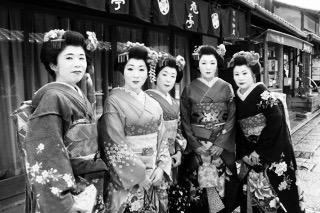
After our meal the sisters brought out their mother’s wedding album, old and falling apart. The photos of Mother in her wedding kimono standing at her husband’s side were stunning. We shut the book and Tomoko said, “Ok, now is time for a kimono fashion show.” They brought out Mother’s wedding kimono and with great care Sonoko dressed me. Tomoko pulled out a full length mirror so I could watch myself be transformed into a geisha. Well, a woman with a fancy kimono on anyway. What a joy to be in this tiny room with these three women excited to share their culture with me.
When the transformation was done and pictures were taken I asked to have one taken with Mother, while she held the photo of herself in the kimono on her wedding day. They loved this idea. I could tell it meant a lot to Mother too, who didn’t speak much, but made constant eye contact with me.
The sisters discussed something and then Tomoko dragged out a pile of kimonos. “These were all my mother’s. She doesn’t need them any more. You may pick one to have for yourself.” They were kimonos used for everyday wear, mostly heavy cotton, for the winter months. I picked the softest one. Tomoko walked back in the room and said, “This one too.” Light, soft and a beautiful blue, I got tears in my eyes at the generosity of the gift. I said I would always think of her mother when I wore it.
It turned out her mother was still able to take walks and travel. They were heading to California that winter. I liked Mother’s spirit. Ninety-two years old and going on a transatlantic flight. I prayed I would do the same into my nineties.
The energy in the room was easy. We enjoyed each other’s company. Tomoko was worried her mother was up so late, after 9. She asked her mother if she wanted to go into her room? Mother shook her head no and ate another chocolate. I laughed and said, “Well, I need to go to bed.” I left the room full of gratitude for being out in this world, so far away from home, yet welcomed into another home.
In the morning, in the bedroom off the dining room, Mother snored like a four hundred pound sumo wrestler, instead of a hundred pound old woman. Breakfast was a piece of white toast, shredded cabbage with tomato, cucumber, and a hot dog. Along with tea or coffee, this was a common breakfast in Japan. I promised I would try to eat whatever was put in front of me on this trip. It was why I couldn’t call myself a vegetarian, even though I didn’t eat much meat.
On a beautiful fall morning, Sonoko and I headed to the Inari Shrine. The streets we walked along reminded me of the Riviera in Santa Barbara, nice houses with beautiful gardens, a bit of fog in the air, a view of Kyoto below us, narrow winding streets. The Inari Shrine turned out to be my favorite of all the shrines and temples we visited that day. Paths ran through the woods and you walked up steps through orange pillars. We almost had the place to ourselves, the birds sang joyously, the day warm and calm. We climbed up and up the mountainside. I tried to keep up with Sonoko, who for someone in her mid-sixties was in amazing aerobic shape. I was dripping sweat by the time we reached the top of the mountain. Later I found out she had tried her best to keep up with me and my long legs.
We headed down a path for the walk back down the mountain to visit more temples in the area. As we walked down the streets with no street signs, I asked Sonoko,”Why don’t the Japanese put street signs up?”
“I don’t know.”
“But I’m sure it’s as much a problem for you as for me?”
“Yes, it is, but I don’t worry about it.” She shrugged her shoulders.
There it was, the essence of Buddhism. I promised myself to try not worrying about it, whatever it might be. Maybe that was why I liked traveling alone. I had no one to whine to and just needed to take things as they came.
That night Tomoko prepared a feast of grilled eggplant, small pieces of chicken wrapped with soy curd in the middle and pan fried, like mini chicken kiev, some sushi rolls and tofu skin stuffed with rice. We ended the meal with a bowl of rice and cut up persimmons. Sonoko asked for the bag of nuts and the three women devoured the rest of them. Mother especially liked the little yogurt chips and dried pieces of fruit. She smacked her lips in approval. The sounds of farting and slurping were added to the concert that night. Mother’s face radiated when she grinned at me. We finished the night off with Sonoko teaching me origami. We laughed at how badly mine turned out compared to hers.
I woke early. The birds sang, the frogs beeped, the crow gave its first caw, a gentle rain fell. I wondered if there was anything more decadent than the heated toilet seats I’d had in my hotel rooms when I first got to Japan. I couldn’t think of anything. But that morning I changed my mind. I didn’t mind a dirty bathroom, or farting and burping sounds, or sleeping on a hard futon. Not if it gave me the chance to step into someone’s home as an honored guest. That was real decadence.