
Holy Week in Spain, called Semana Santa, is celebrated during the week from Palm Sunday to Easter Sunday. Catholics, especially those in southern Spain, come out in full force to commemorate and mourn the last days of Jesus Christ’s life and to sympathize with the grief felt by the Virgin Mary.
The traditions of Semana Santa originated from the medieval “Reconquista” (re-conquest) of Southern Spain of the Moors by the Christian kings. Hermandades (brotherhoods) were formed during the re-conquest to rescue injured soldiers from battlefields and to bury the dead. By the 16th century the tradition of processions to symbolize the journey of Christ to Calvary was firmly established.
Processions leave town churches to wind slowly through the streets carrying statues of Christ on the cross and the Virgin Mary in mourning. In the larger cities like Sevilla and Malaga there are as many as fifty processions during Holy Week, many starting in the evening and lasting through the night.
On the Monday after Palm Sunday Cradoc and I ignored the threat of rain and went to the Plaza de la Iglesia to catch the start of the Juvenile Procession. We arrived at 4:40, just five minutes before the procession was set to begin. There was nothing happening and only a few people stood around the plaza.
We decided to walk to the bridge on the other side of the old town where the photo on the poster announcing the procession had been taken. Sure enough the procession was lined up waiting to see if it would rain or not.
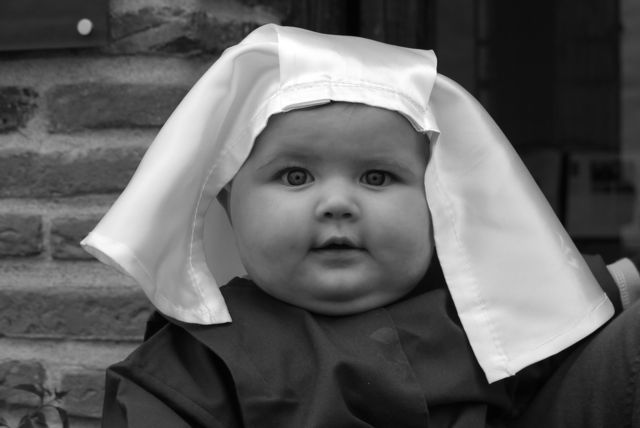
A minute later the decision was made to start the procession. The air became charged with the excitement of the young people. At the head of the Marbella Juvenile Procession stood a group of twenty children, ages ranging from two year olds who could barely walk, to adolescent boys and girls dressed in bright blue robes with a long white cord wrapped around their waist. They wore white gloves, a white satin cowl on their head and had a thick twined blue and white cord around their neck with an image of the Virgin Mary. They each held a two foot wooden cross in one hand and the youngest in the group also tried to hold onto their mother’s hand.
They were followed by a group of sixteen young girls dressed in black dresses, with black lace veils draped over their heads. They wore black lace gloves and in one hand held a metal scepter and rosary beads with a cross at the end dangled from the other hand.
Behind them came four boys swinging brass balls of burning incense like baseball bats and the smell of frankincense mingled with the moisture in the air. Two teenage girls ran up and down the street trying to keep the children in order.
Then came a float with a life size wooden statue of the Virgin Mary draped in a long blue cape. It was adorned with lit candles, white roses, purple heather, fern leafs and white lilies and was carried on the shoulders of eighteen teenage boys and girls also dressed in blue robes and white satin cowls. The brass marching band followed closely behind.
The procession started off slowly, barely moving down the street. A few minutes later one of the teenage girls put out her hand and felt rain drops. She put the white statin hood over her head and stared out from two eye holes as she rang up the street ringing the hand bell loudly; a signal to stop the procession.
The mood changed. The children in the procession started to cry when the order came to turn back. It was a privilege to be chosen to be in the procession and a special honor to be one of the bearers of the float. The crowd cheered them on as they walked solemnly back up the street.
By the time the float was maneuvered around the corner into a courtyard the rain had stopped. The crowd went crazy yelling for the procession to continue, “Venga, venga. Viva.” (Come, come, long live). The tears of sorrow turned to tears of joy as the decision was made to keep going. The band started to play again as they made their way up the narrow street. The float followed behind rocking rhythmically side to side to the music.
Rather than turn back towards the Plaza Inglesia the procession kept going around the block. A slow, very slow, procession. When the float was put down for the bearers to take a rest the procession stood in place waiting for them. The small floats in the adult processions are carried by 30-40 men and weigh between 2,200 and 4,500 pounds. Larger floats weigh over 6,500 pounds. This float was tiny in comparison.
Since the procession went a different route than the one planned we were enveloped into the neighborhood with no other tourists around. We joined the line of parents who walked along the side of the road with their children. Parents loved when I took a photo of their child and some even pushed their child in front of me to get in a picture.
An hour and a half later, just as the procession turned the corner back to the start, a wild stormy wind blew up and rain poured down. Those few moments were complete chaos when the teenage girl with the hood over her face rang her bell again and yelled to the young people to run, to hurry, to come, but the narrow street stopped people from moving forward. Someone tried to throw a piece of plastic over the Virgin Mary but the wind blew it off.
As the float turned to go into the courtyard the rain stopped again. The bearers lifted the float as high as they could for all to admire while people from the balconies threw rose petals. Families stood in doorways with tears in their eyes and people shouted “Guapa, guapa!” Beautiful, beautiful.
I was pinned to the wall as the brass marching band came to a stop, the horn section two feet in front of me. A young boy blew his trumpet painfully out of key as the band played another mournful song, filled with longing and hope and a hint of despair. I watched the rose petals drift into the wind as people clapped and cheered.
Then the rain started again and didn’t stop for the rest of Semana Santa. Almost all the processions were canceled in the cities in Andalucia. It was the wettest Easter week in decades. The news showed crowds of disappointed people crying.
On Easter morning we went to the 16th century parish church, Our Lady of the Incarnation, to watch the Easter procession, but I felt more like a bystander to a parade rather than a participant like I had with the Juvenile procession.
The day after Easter the sun came out and has shined every day since.
Story from an online newspaper:
This man is to be released from prison as part of a tradition which dates back to 1765.
The prisoner freed by El Rico in 2009
“The Málaga brotherhood El Rico, is to pardon a Marbella drug trafficker this Easter on Holy Wednesday as part of a tradition which dates back to Carlos III in 1759.
According to the story, back in 1765 there was an outbreak of cholera which killed many citizens of Málaga. Due to fear of infection, during Holy Week there were no men available to carry the statue for its yearly procession. Hearing of this, the prisoners of the county jail escaped in order to carry their Christ. All of them returned to jail voluntarily after the procession and the epidemic subsided. For this reason, the King Carlos III ordered for a prisoner to be released every Holy Wednesday from then on.
The cabinet meeting on Friday granted pardons to 17 prisoners from across the country, including A.C.D., a married man from Marbella who has two children and who was sentenced to prison for three years for small scale cocaine trafficking.
The 51 year old will now have to be hooded and lead the brotherhood’s procession through the streets of Málaga on Holy Wednesday to be granted his pardon. He’s been in jail since November 11 last year, but has a good record and has been occupying his time in jail learning French and taking part in literary forums.”
Another story from the local English paper:
“The family of a little girl in Almogia (Malaga) paid 1,450 euros so that she could play the angel during one of the Easter processions in the town. Another young woman in the town has paid 1,000 euros to play Mary Magdalene, and the family of a little boy paid 600 euros to ring the bell in front of the procession.
Although these prices may seem excessive, some years back, a woman paid 6,000 euros to play Mary Magdalene. Each year since the 1940’s, the town hall has held a public auction for the roles of the main Biblical characters.


No Comments