
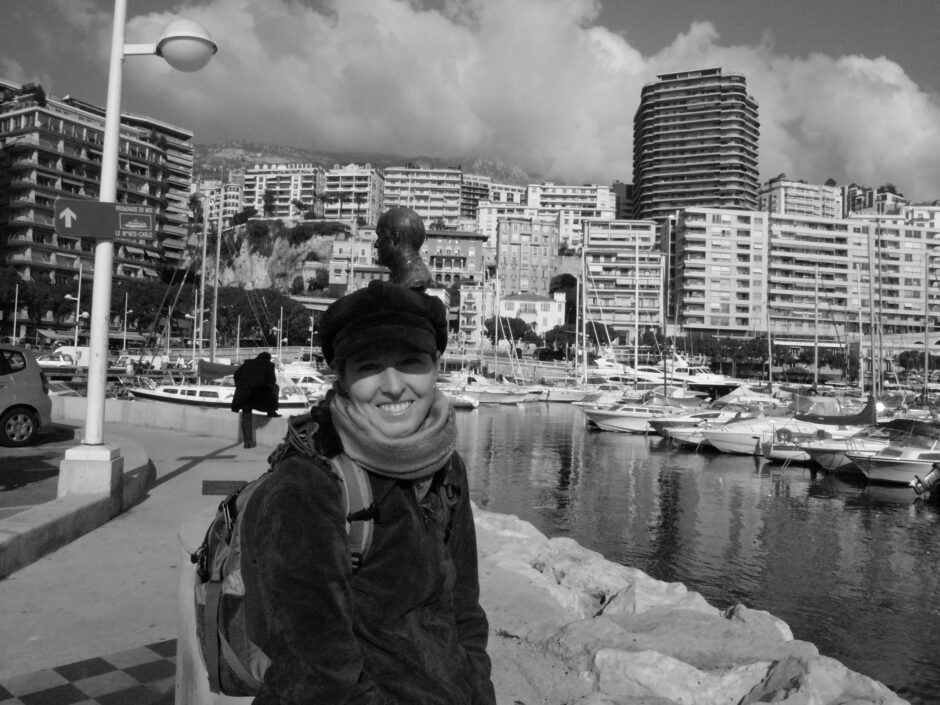
One day last week we took a short trip across the border to Ventimilla, Italy. The minute I stepped from the train I was hit with the wall of chaotic exuberance that was Italy. The noise, the people embracing and touching each other, yelling, laughing, and smiling. Oh those beautiful smiles.
I found the French people so reserved. If you smiled at someone on the street for no reason they thought you were crazy, making fun of them, flirting, or wanted something they didn’t want to give. The train ride to Italy had been silent except for an Italian woman speaking loudly on her cell phone, getting sour French looks from the people in her immediate area.
In the small town of Ventimilla, I walked across the street. The approaching car actually stopped because I was in a crosswalk. It took me a few seconds to realize the driver was waiting for me to cross, not waiting to hit me. The new non-smoking law had been passed in Italy and was being enforced, so I could enjoy lunch in a small cafe, something I wasn’t able to do in Nice. The streets were clean, not covered in dog poop. Nice was just as bad, maybe worse than Paris in the dog poop department. I recently read the following: sixteen tons of dog merde were cleaned up off the Paris streets each year and six hundred people go to the hospitals in Paris from slipping in poop. I thought of buying little French flags to stick in the assorted piles of poop I passed, but I didn’t find the flags yet.
Italy had its own problems, but expressing themselves, non-smoking cafes, and clean sidewalks weren’t on their list.
Ireland, the United States and Immigration
I recently met our downstair neighbors, Mary and Larry, from Dublin, Ireland. They owned two apartments in Nice. I told them the last time I was in Ireland was in 1986. They said the changes in the last twenty years were amazing. The change started in the late 1980’s with the tax incentive program to entice businesses to Ireland. It worked. They became the fastest growing country in the EU.
Mary: “Ireland was quite lax with its rules and the immigrants from poorer countries know which country offers the best social services with the least hassle. And Ireland was the number one choice. All someone from Nigeria would have to do is go to Ireland and have a baby. The baby was instantly given Irish citizenship, and then the parents had a legal right to stay in the country forever. The airport was filled with pregnant Nigerian women arriving in Dublin and two days later having their baby. They would then get free medical and government help for housing and food. The Irish government refused to talk about the Nigerian issue because they didn’t want to admit there was any problem with their immigration policies. But finally they stopped the instant Irish citizenship for the babies and are now getting accused of discrimination. All their immigration policies are getting a bit stricter. Immigrants from other parts of the world do not put such a toll on the social services and they come to Ireland and find jobs and try to mix in the community.
Larry: “There is a whole village of Brazilian butchers, one hundred of them with their families, who have come to help in the meat industry. Over 200,000 Polish people have moved to Ireland. Even the French are moving there.”
Me: “Do your children have any interest in coming to France to live?”
Mary: “Why would they, no. There are no jobs here and they can find work in Ireland the day they get out of college. Good paying jobs. And they love Dublin. Its turned into quite a young person’s city. Very expensive though. Especially housing, restaurants, doctors, hair dressers, food. They know we’re making more money and being taxed less, they know we can afford it, so they charge more. The corporate tax rate is 12.5% The personal tax rate peaks at 20%. In France it can be 70%. Why would they want to come here? They don’t even come here on holiday very often. They want to go places where there are more young people and more is happening.”
Me: “How do you feel about the changes in Ireland?”
Mary: “Well you wouldn’t recognize it from twenty years ago. Most of the people want to live near Dublin. There isn’t much interest in the rural areas on the west coast. I think the government doesn’t have a good enough plan for the immigration. What’s going to happen when the kids of all these immigrants need jobs. Are they going to be willing to be butchers? What if the companies start to pull out, like one large American software company did because the tax advantage was no longer advantageous to them because of some ruling from the IRS. What will Ireland do with all these people when the economy isn’t so strong? I don’t think they have thought about that.”
Me: “Does Ireland have better mass transit now?”
Larry: “You can’t believe all the new roads we have in. There is a four lane highway from Dublin to Shannon. You can get there in half the time now. Well, that’s not really true, there is so much more traffic on the roads, it takes nearly the same amount of time. Ireland’s whole infrastructure is being stressed with so many new people in the country. We come to France to go to the doctors. Its much less expensive and we can get seen right away.
“But things are very expensive here also and the customer service is appalling. You wouldn’t get away with that in Ireland. It took me five trips to the store to buy some paint. The first time I went they were closed for lunch. The second time it was around 10:00 and I was told the person who mixes the paint wouldn’t be in till after 2:00. I didn’t wait. I went back the next day without thinking it was a Saturday and the store was closed. Then I went back, ordered the paint and was told to come back on Friday to pick it up, this was on a Tuesday.”
I had just listened to a podcast by John Naisbitt, the author of “Megatrends.” He was talking about his new book called “Mind Set! Reset Your Thinking and See the Future.” He thinks because of the lack of economic reform in Europe that “Europe will continue on the path to a mutually assured decline.”
He continued: “Europe has a birth rate of 1.3. You need a 2.1 birthrate to sustain your population. And they won’t take in any immigrants to make up for the short fall. If these two things continue in just two generations Europe will have one half the population it has today. Europe, at its peril, is not admitting immigrants.
“Its not by chance that America is the most successful country economically in the world because of its immigration policies”, said Naisbitt. “What the United States is doing is replenishing its talent pool. The United States takes in more than one million legal immigrants every year, more than all the rest of the world put together, and they have been doing that since 1976. They come for the freedom to work and make their dreams come true. These are the most talented, entrepreneurial, aggressive, feisty people. These immigrants come to the U.S. for opportunity. The immigrants who are trying to get into Europe go because of the social welfare programs. This is a very different type of thing.”


