
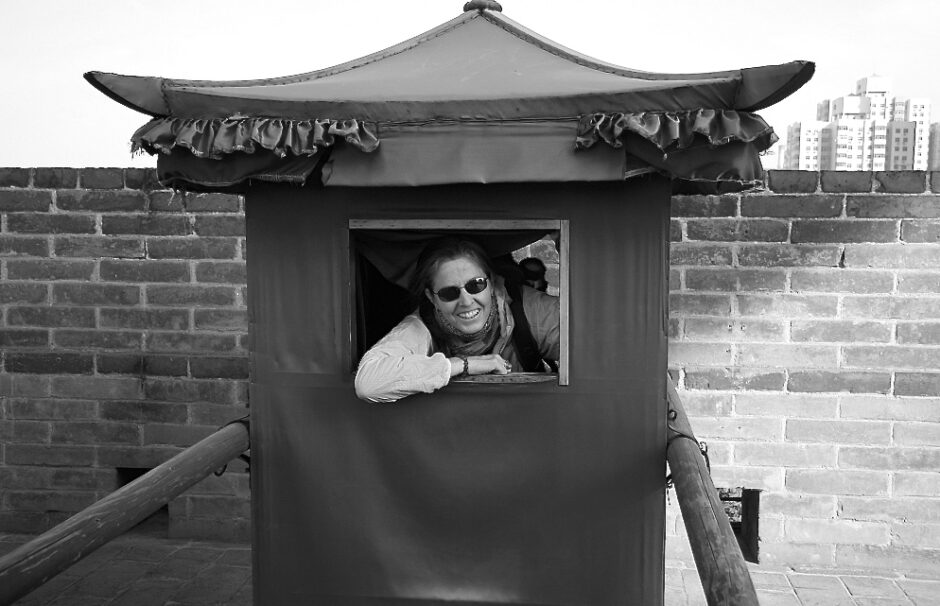
The nine day Taste of China tour with Intrepid Travel included the cities of Beijing, Xi’an, Suzhou and Shanghai. It was the first travel tour I ever joined. I’d heard how hard it was to travel in China on your own (or even get a train ticket). I wanted to take advantage of a local person’s expertise on where to eat, and have experience I wouldn’t have on my own.Intrepid limited their groups to twelve people. Our group included six men and three women. Ages ranged from mid-twenties to mid-fifties.
Our first day together, early on Sunday morning, we took a minibus to the Mutianyu section of the Great Wall, sixty miles north of Beijing. On the drive I couldn’t take my eyes off the passing scenes outside the window. The howling wind swirled up dust and sand. The people on their bicycles, motorbikes, and strange little vehicles piled high with recycling, looked miserable. We drove from the city, past poor industrial areas, along open fields, to small villages surrounded by mountains.
The Great Wall wound 3,800 miles through mountain passes, valleys, and deserts. The fully restored Mutianyu section, constructed during the Qi Dynasty (550-577), was fourteen miles long, twenty-six feet high and sixteen feet wide, with twenty-two watchtowers. We arrived early, before the hoards of tour busses. We past the vendors setting up their souvenir stands, past a man dressed like an ancient warrior playing checkers on a huge wooden board with another vendor, past a camel you could pose next to – for a price. We took the gondola up to the 14th gate of the wall, saving a half hour hike up a dirt walking path. We wanted to spend the few hours we had hiking on the Great Wall.
I turned left to the steeper part of the wall, the less busy side and hiked up the steep incline in the quiet, sunny morning, surrounded by clear blue skies, mountains and forests. In my youth I dreamed of walking on the Great Wall. In 1984, when I lived in Vermont, a boyfriend invited me to go to China with him. His uncle worked at the Embassy in Beijing and could get us visas. I didn’t go. He did. Every postcard he sent made me feel miserable about my decision. I taped the posted from the Great Wall on my refrigerator and said, ‘On day I’ll get there.’ Twenty-six years later, as I stepped onto the Great Wall, I crossed off another regret from my “God, I wish I had done that” list.
I walked for an hour on the almost empty wall, climbing higher and higher on steep stairways that leveled off to watchtowers and lookouts. On the way back down more and more people stopped along the stairways to catch their breath from the climb. The wind caught up with us and the few leaves left on the tress were carried high above the Great Wall. The Great Wall stretched across the mountain landscape and disappeared over the ridge. Michael, our tour leader had said,“There is a saying in China, ‘If you haven’t been to the Great Wall you haven’t lived.’” I was living my dream with each step along the ancient, uneven bricks and stone.
When it was time to leave we took the gondola back down. At the bottom of the hill, near the entrance, the place swarmed with people and busses. Vendors, now in full swing, aggressively hawked their souvenirs by pulling tourists into their stalls. “Two T-shirts one dollar. You look.” Once the vendor got you in the stall they blocked the exit like a 300 pound sumo wrestler and harassed you to purchase something. I kept my head down and made sure not to make eye contact and escaped entrapment. Other members in my group weren’t so lucky. One guy who couldn’t get out of a stall agreed to buy two T-shirts for a dollar, but that sale suddenly ended. The vendor now wanted $8 for one T-shirt. She pointed to the sale T-shirt. “Not this one. This one too cheap. Nylon. Wash twice and bye-bye. This one good cotton. You feel.” She shoved the T-shirt at him. He looked at us for help, but we left him to fend for himself. The peaceful walk I had on the Great Wall was the best souvenir I could bring home with me.
I disliked shopping. No, I hated shopping. So when we stopped at a huge marketplace on our way back to Beijing all I wanted was some food. The vendors in the marketplace were as aggressive as at the Great Wall. “Hey Lady, you want a sweater. Winter coming.” One vendor tried to elbow me into her stall. I elbowed her back and kept going. I couldn’t believe people found this kind of shopping fun. The merchandise looked like junk I could buy cheaper at Walmart. The rest of the group weren’t big shoppers either. We went to the fifth floor for a late lunch. I found the perfect meal; a soup made with chicken stock, rice noodles, and vegetables. While everyone else ate greasy food I slurped happily as they all asked, “Where did you find that?” “I want that!”
As we crossed the parking lot to get back onto the minibus a group of beggars walked towards us with cups in their hands. One old guy looked so miserable, and not in a fake way, but completely down trodden. I made the mistake of giving him a 1 yuan bill (20 cents) for a pair of socks he wanted to sell me. Like a scene out of the horror movie, Night of the Living Dead, the rest of the beggars walked towards me in a zombie like fashion. The rest of the group made it onto the bus, but I was surrounded and my path was blocked. There was no aggression, just people in great need looking me in the eyes pleading for some of my money. I inched my way towards the mini-bus, tapped on the closed door and was let in. Everyone said all they could think about was “saving themselves” from that experience. I started to understand the Chinese philosophy of every man for himself. When I asked the local tour guide we had with us for the day why the beggars weren’t taken care of in a Communist country she said, “Perhaps China is no longer a Communist country.”
The next day harsh cold winds joined us for our tour of the Forbidden City and Tiananmen Square. As I stood in the largest city square in the world I said a silent prayer for all the student protestors who died there in 1989. Supposedly the square was now filled with plain clothes police. Two weeks after I was at Tiananmen Square a thirteen year old American boy, Jonathan Lee, tried to hold up a protest sign and couldn’t even get the sign unfurled before a plain clothes policeman grabbed it from him. The boy and his mother were led off by four uniformed policemen, held for a few hours and then deported from the country. Jonathan’s banner read: “End the Korean War. Sign a Peace Treaty. Nuclear Free. DMZ Children’s Peace Forest.” He wanted to get a peace park constructed in the demilitarized zone between north and south Korea.
That evening we went to the Beijing train station to catch a twelve hour overnight train to Xi’an. The massive station was complete chaos with every seat taken in all the waiting rooms with people sprawled over the floors next to huge sacks filled with who knows what. “The trains are always full,” Michael said. “You can never go to the train station and expect to jump on an overnight train. There are so many people using mass transit in China that the subways, buses, trains are jammed full most of the time.” After warning us about pickpockets, the group huddled together waiting to board.
The train itself was clean and safe. Each compartment had its own attendant. Our ‘hard sleeper’ car had padded three tiered berths, six to each compartment. Hot water was always available out of a huge vat at the back of each car. The toilet, which dumped right onto the tracks, was kept cleaner than I expected. Smokers stood in between the cars to smoke since smoking in the cars of Chinese trains was now prohibited and enforced.
Two Chinese men slept in the upper bunks and four of us in the lower ones. The lights were turned off at 10:00 P.M.. I was surprised how well I slept as the train rambled through the countryside. Every time I woke up I peeked out the curtain and saw the lights of factories. China seemed like one long, endless industrial zone.
In the morning a food cart went up and down the isle. The people on the bottom bunk were expected to share and keep it cleared off so everyone else could sit on it in the morning.
As I ate the instant oatmeal I’d packed from home, I peeked out from the curtains and saw another huge factory lit up spewing out smoke. The busses were electric, the people rode electric scooters, more train and subway lines were put in everywhere, but their landscape was covered with factories and their cars covered in coal dust. I wondered where China would be in ten years, even five years.
Xi’an
We arrived in Xi’an around 8:00 A.M.. After a quick check into our hotel we were joined by a local tour guide, Susan, for our trip to the see the Terracotta Warriors, a collection of sculptures depicting the armies off the first Emperor of China. When we got to the museum Susan told us a story. “In 1998 Bill Clinton came to visit the museum and he wanted to meet the farmer who discovered the warriors in 1974. The farmer was digging a well when he found the head of one of the warriors. He was given a few yuan from the government and went back to farming. The officials told Bill Clinton, “He is just an illiterate farmer, a nobody.”
But Clinton insisted on meeting him. So the officials went to farmer Yang Zhifa to tell him he would be honored to meet an important person and he must learn two English phrases: “How are you?” and “Me too.” So he practiced hard and when he met Bill, Hillary and Chelsea the farmer said, “How are you?” but his accent made it sound like, “Who are you?” Hillary said, “I am Hillary,” and Bill said, “And I am Hillary’s husband,” to which the farmer replied, “Me too.” Susan pointed to a man sitting behind a big desk in the gift shop signing books for a long line of tourists, “That is Yang Zhifa. His life is very easy now since Bill Clinton made him famous.” But to me the old man looked miserable. Pasty white with eyes glazed over it looked like he longed to be back in his fields. He sat next to a sign that said, “no photo, no video.”
When I returned to the U.S. I dug further because, being somewhat skeptical, I wondered if that old man really was the farmer that discovered the Terracotta Warriors. Yang Zhifa now gets a salary of 1,000 yuan ($147) a month to sign the books that cost 150 yuan each (up to five hundred books a day sell during the peak season) and was quoted as saying, “I’m tired of signing and the noisy tourists…”
On the drive back to Xi’an I talked with Susan, a woman in her late twenties and single. I’ve changed her name since freedom of speech was still frowned upon in China. Local tour guides were hesitant to talk about politics or sensitive issues. I found Susan’s openness and honesty refreshing. She shared the following:
China’s Economy: “In the last two to three years things have gotten hard for people. The number of tourists visiting is down. Young people coming out of school find it very hard to find work. Families are paid a compensation to give up their rural homes to make way for urban development, many take the money instead of a replacement home so their child can go to university. Now in China 50% of the young people are getting a university degree but when a good job is posted thousands of people apply for that one job. There is lots of competition.
The average worker in Xi’an makes 1,000 to 2,000 yuan a month (Beijing around 3,000 yuan for university graduates…$150-$450 US). Rent for a small apartment is 1,000 yuan so many families have to use all their earnings to pay the rent. They find other work to get enough money to get food. But you don’t hear about these problems because the Chinese news will only tell you the good news.”
Forced retirement: “Factories have started to loose money and people over forty years old are being forced to retire early to make way for younger workers. With a pension of about 1,000 yuan they need to take menial jobs to make enough to live on.”
Young people: “Parents who have saved their money give their children money for the 20% down payment on homes they can’t afford. The children don’t want to save, but they are willing to take the money their parents saved. When they can’t pay their credit card debt they ask their parents for help and don’t feel guilty about it.”
One child policy: “China has a problem with an aging population. There are many more DINKS in the big cities now, Double Income No Kids. Many young people don’t get married until they are older. They don’t want the responsibility. I want two children. The life of one child is too lonely. It’s not good for the country. I will pay the fine.” (In Beijing there was also a One-Dog-Policy and no dog could be bigger than fourteen inches).
The one-child program theoretically was voluntary, but the government imposed punishments and heavy fines on people who didn’t follow the rules. Parents with extra children could be fined, depending on the region, from $370 to $12,800 (many times the average annual income for many ordinary Chinese). If the fine was not paid sometimes the couples land was taken away, their house destroyed, they lost their jobs. Or the child was denied a birth certificate and was not allowed to attend school.
One Child Policy Now
I asked a few people in China about the one child policy and received different answers from all of them, but I narrowed it down to the following:
*If a couple came from a family with no brothers or sisters they could have two children.
*If one person in a marriage had a master’s degree, they could have two children.
*In the countryside they could have a second child, if the first one was a girl. If they had three children they paid a fine.
*Minority ethnic groups in the Northwest could have two or three children because the government was trying to preserve the ethnic community.
*Fertility treatments were frowned upon in China, but many women went to Hong Kong for the procedure in hopes of having multiple births to get around the one child policy.
*If the first child was born with any kind of handicap the couple were permitted to have a second child.
Parents had been known to bribe doctors to document a second child as a twin to the first even though the second child was born years after the first one. There were stories about twins who were born ten years apart. The practice was so common in the Guangzhou area that pregnant women were asked, “Is it your first child, or are you having twins?” Others got approval for a “second-first child” by giving birth in a hospital that had no record of their first child. Others “parked” second children with childless relatives, or friends.
Crude family planning slogans such as, “Raise Fewer Babies, But More Piggies,” and “One More Baby Means One More Tomb,” and “If you give birth to extra children, your family will be ruined,” were banned in August 2007, shortly before the 2008 Olympics.
But now China had a problem. Their population, like that in the U.S. and Japan and many other countries, was aging. To address concerns about taking care of this aging population, and the workforce shortages of the future, since 2009 eligible couples in Shanghai (where the husband and wife were only children), where the birthrate was less than one child per couple, had been encouraged to have a second child. One-child policy posters in Shanghai were torn down and replaced with details about how to apply for permits, but many couples were not choosing to take advantage of the new program because of financial reasons.
Many attribute the lack of interest in having additional children to selfishness. A human resources manager and single child told the Washington Post, “We were at the center of our families and used to everyone taking care of us. We are not used to taking care of others and don’t really want to take care of others.” The owner of a translation company said, “Ours is the first generation with higher living standards. We do not want to make too many sacrifices.”
Back in Xi’an, a modern city with eight million people that was the Imperial center of China for over two thousand years, was much poorer than Beijing. We headed back to the dank and depressing hotel. In a dimly lit room with a carpet so disgusting I couldn’t stand to walk barefoot on it, a room with no hot water and not heat, I searched a long time to figure out how to turn the heat on with no luck. We had been given a tiny roll of rough toilet paper to use, so we didn’t waste any.
That night on our walk to the concert hall for an eighteen course dumpling dinner and Tang Dynasty Royal Concert show we had some near misses as we tried to cross the street, even with Michael helping us. “You just get used to it,” he said. But I never would. Maybe I should’ve chosen a tour in the rural areas of China. I needed some quieter times. More yin to the yang. I was more balanced in Beijing because I spent so much time in the parks.
We arrived a bit late for our eighteen course meal and were served cold, hard dumplings. But even hot I don’t think they would have been any better. We ate in a huge room with round tables filled with other tourists, like a cruise ship. Then we went down to the concert hall. The show was a “spectacular.” All lights and vibrant colors to cover up the lack of anything substantial. I put in my earplugs and prayed the show wouldn’t last long. Only one hour and ten long minutes.
Before we left Xi’an, I wanted to bike on the 13 km (8.5 miles) ancient wall around the city, the most complete city wall that has survived in China. Built in the Tang dynasty (619-907) the Xi’an city wall was forty feet high, forty feet wide and fifty feet thick with a moat all around it. Andy and Phil, two British guys in my group, were the only ones willing to get up early to join me; everyone else slept in after a late evening at a nightclub I’d passed on.
The sky was blue in the early morning, but like a looming rain cloud, I saw a massive wall of pollution heading our way. We rented rigidity one speed bikes with seats that were too low and chains that kept falling off. We bounced along on the rough cobblestone pavement past ramparts and hanging red lanterns. We took our time, stopping often to look down at the people doing their morning exercise in the park below us, watched shoppers bustling on the market street, and most surprisingly, checked out many of the old buildings that had solar panels on their roofs.
A magical and fun ride. We didn’t realize it would take so long to come full circle. We pushed hard at the end to make it back to the hotel in time to join the rest of the group, all hungover and grumpy.
We went to the Huiling school, a day facility for mentally challenged people from fourteen to forty years old. Some of the residents performed a rap song and danced for us. We ate a bowl of delicious homemade tomato noodle soup, then came together in a circle to do the Hokey Pokey dance with much laughter by all. “You put your right hand out, you put your right hand in, and you shake it all about.” The school was a project supported by the Intrepid Foundation, part of Intrepid Travel, who supported many similar projects to try to improve the lives of people in communities all over the world.
Suzhou
That night we left for our fifteen hour overnight train ride to Suzhou. I loved train rides and this one was an adventure with open berths, six of us in one and four in the one next door. We pulled into the station at 11:30 A.M.. I was surprised to see more factories and high rises out the window. I thought we were going to a small “town.”
We checked into the Gusu Hotel, thankfully a nice hotel, with good energy, hot showers and clean carpets. We went to lunch at an excellent restaurant next door. In each city Michael knew where to eat and what to eat. He ordered for all of us and paid extra to have sanitized shrink-wrapped plates and cutlery. We ate extremely well and stayed healthy because of this. Since we were a large group we usually sat in a private room far from the cigarette smoke. That night we ate a local speciality of thinly sliced mushrooms sautéed with ham, an egg omelet with small fish on top, bok choy with mushrooms, shredded potato salad, noodles, and a corn like pizza for a sweet finish. Andy and Phil decided they wanted pizza instead, but paid the price of food poisoning.
Suzhou, an ancient city built in 514 BC in the Yangtze River Delta region, was known for its traditional gardens, pagodas and stone bridges. Since forty-two percent of Suzhou was covered by water, Suzhou was called the “Venice of the East.” But the city of six million people (875,000 in 1990) was bustling, polluted, dirty, crowded. The city had changed quickly since a four lane highway and high speed train now connected it to Shanghai, seventy-five miles to the west. Now Suzhou was a main industrial center, known for its cotton, silk and wool. The guide books didn’t mention these changes. It seemed like I’d never get away from the city energy in China.
Many of the ancient gardens in Suzhou were destroyed during the Japanese invasion in 1937. Renovations on the gardens started in the 1950‘s. We visited one of them, the Master of Nets Garden, a typical Chinese garden with a small courtyard, rock formations, a pond, bridges, gazebos, walkways and an old residence filled with the original furniture.
Afterwards, I joined five people in our group for a gondola ride, Chinese style, in an old neighborhood along the Grand Canal. Instead of the sleek, black, glossy gondolas of Venice, these narrow Chinese boats were squat, varnished natural wood, and blunt nosed. The passengers sit in a small gazebo in the center of the boat and the gondolier stands in the back and sculls the boat along with a continuous back and forth motion of the rudder.
Marco Polo described Suzhou as a charming merchant town of whitewashed houses, tree line canals and sumptuous gardens. As we drifted on the narrow canal past stone bridges, the back yards of homes where laundry hung to dry, willow tree branches draped across the canal. We past cafe tables with umbrellas and people waved down at us from the canal wall. I got a glimpse of that past. Not exactly Venice, but close enough to make me think this was where the Venetians got the idea for their boats, just like they did for pasta, movable type and so many other things Italian. Thank you Marco.
We made our way slowly down a warren of canals. The gondolier, an older man dressed in a scruffy communist style grey jacket and blue pants (no black striped shirts here), broke into a haunting Chinese folk song that gave me goose bumps. Then Michael, who’d joined us on the ride, also broke into song. The sun set in the late afternoon. The light turned golden. This peaceful, simple thirty minute boat ride, which turned out to be a highlight on the tour, helped scrub off some of the city grime clogging my lungs and my spirit.
Shanghai
It took just twenty-five minutes by high speed rail to get to Shanghai from Suzhou. The minute I walked off the train in Shanghai, the fastest growing and most populated city in China, the energy felt different. People seemed happier and were dressed fashionably. There was a buzz on the street. The air was warm and humid and the pollution level was low. And vehicles actually stopped for us in cross walks.
Over the next two days in glitzy Shanghai we went to see the Shanghai Acrobatic Troupe perform (amazing), went to the Bund – an area along the banks of the Huangpu River filled with boat traffic of every kind. We explored the Pudong New Area – a “free economic zone” filled with skyscrapers, hotels, and office buildings for over two thousand foreign companies. Over four thousand skyscrapers, double the number of New York City, loomed above us. Before 1990 the land was occupied by farmland and marshes. Construction had begun on the 128-story Shanghai Tower, that would be plunked down on a former rice field next to the 101-story Shanghai World Financial Center (2008), currently the second highest building in the world. Since it was owned by a Japanese developer the building was designed to look like a samurai sword. This building dwarfed its neighbor, the soaring pagoda like 88-story Jin Mao Tower (1999). The nearby futuristic landmark of Shanghai, the 1,500 foot high Oriental Pearl TV and Radio Tower, started the whole race for height.
On a clear night we went to the Jin Mao Tower and took the elevator to the Skywalk observation deck, reaching the 88th floor in forty-nine seconds. The panoramic views of Shanghai were spectacular and it was hard to believe the erector set like skyline had been there just over twenty years. The experience was a bit disappointing because the observation deck was enclosed in glass. In the 1970‘s, when it was first built, I visited the outdoor observation deck on the 110th floor of the World Trade Center where the building swayed in the wind, 1,368 feet above Manhattan.
Back at the hotel, posted on the elevator wall, was a full color glossy advertisement, with photos, enticing guests to the hotel restaurant. The text, spelling mistakes and all, said, “Joy diffuses the magnificent and fragrance swims across chrysanthemum hall, where delicious dainties, tender feeling, drink to your heart’s content and family ger-together are satistied fully.”
I was run down from the hectic pace of the tour, now officially over. I spent an extra day in Shanghai on my own. Two of the guys in my group, Eric and Alan, also spent an extra day and on Monday morning we headed to the metro to go to the airport together. It was rush hour. When the first train arrived in the station there was no way we could get on, it was so packed. The second train came and it was the same. I turned to Eric and said, “Are you sure you don’t want to take a taxi?”
“Don’t worry, we have plenty of time,” he said. “We’ll wait for the next train.”
When the next train pulled up it was just as packed. The doors opened and there was a commotion from deep in the train car. Before the doors closed a young woman was pushed out of the car onto the platform and landed face down at my feet. She was out cold and must have passed out from the crush in the car. In true Chinese fashion the other passengers ejected her. She wasn’t their problem.
The woman laid on the platform still unconscious. “What should we do?” Eric said. As we leaned down to help her a whistle blew and a station attendant waving a flag ran over to help. He arrived as she was coming to. Another train pulled into the station. Eric, a big man, pushed his way into a crowded car. I held onto him and followed. I closed my eyes, took deep breaths and dreamed of far away places.
The reason Eric and Allan wanted to take the metro was to transfer to the Shanghai Maglev Train, a magnetic levitation train that gets up to a speed of 431 km/h an hour (268 mph), making it the world’s fastest train since it opened in 2004. France’s high speed TGV, the previous recorder holder, goes only 320 km/h.
Powerful magnets lifted the entire train about 10 millimeters above the special track. Other magnets provide propulsion, and braking, and the speeds – up to 500 km/h in test runs, were attained largely due to the reduction of friction. The train reached a sped of 300 km in two minutes. I knew because overhead an LED display tracked the speed until we hit the top speed of 431 km/h. We sped through neighborhoods of rundown tenement apartments, construction sites, huge power lines, factories, office complexes, highways, bridges, and homes surrounded by trees and farmland.
China was in another cultural revolution. Mao’s dreams of a modern industrial country were coming true. It seemed China was trying to run from its past using technology, but the problem was there were people outside those train windows who weren’t along for the ride, millions and millions of them. How China would deal with the gap that was being created would determine whether they were successful in becoming the world power they were expecting to become.
Noiseless and smooth as glass, with the past blurred outside my window, we traveled the thirty km trip to the Pudong Airport, and into the future of China, in eight minutes flat.


